
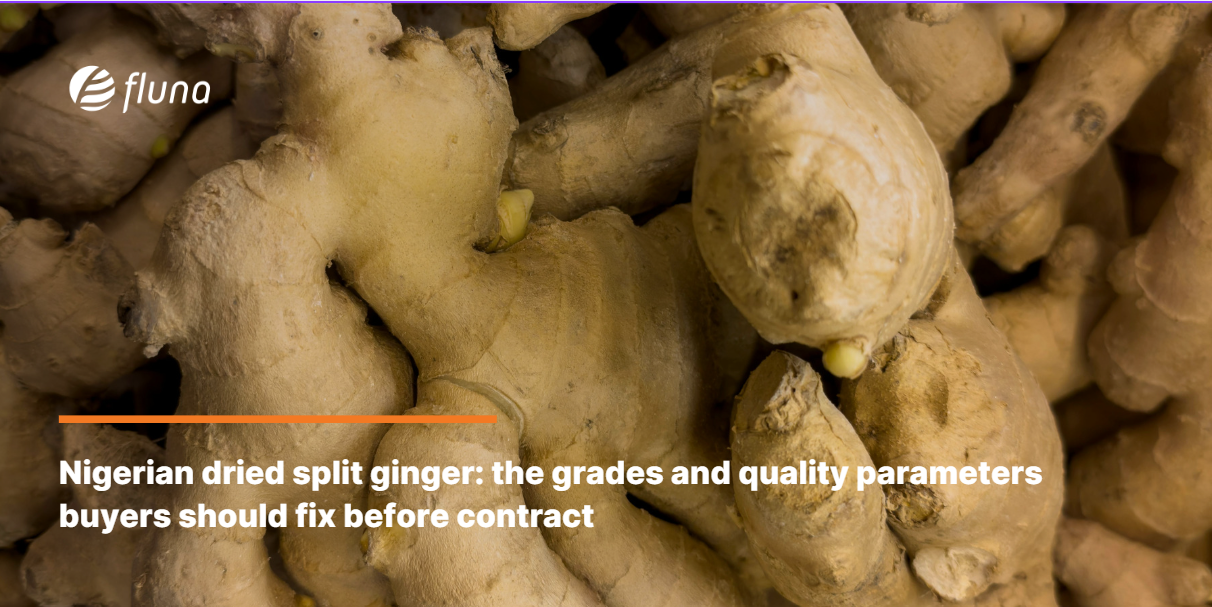
Nigerian dried split ginger: the grades and quality parameters buyers should fix before contract
By Sandra Nansbuga
Nigerian dried split ginger: the grades and quality parameters buyers should fix before contract
Nigerian dried split ginger is graded against a published quality minimum that fixes moisture, ash, volatile oil, pungency and extraneous matter before the lot is bagged. Add the contaminant limits that apply at destination, and a Kaduna-sourced lot has a standard to be measured against at loading and on arrival.
What does the Nigerian Grade A standard for dried split ginger measure?
NGPPMAN, Nigeria's ginger producers and processors association, publishes the Grade A standard for split-dried ginger. It sets moisture at a maximum of 12 per cent, total ash at 8 per cent, acid insoluble ash at 2 per cent, volatile oil at a minimum of 1.5 per cent, gingerol above 1.5 per cent, and extraneous matter at 1 per cent.
ISO 1003:2025, published in April 2025, specifies requirements for dried ginger in whole, pieces and ground forms. Gulf buyers work to GSO ISO 1003:2021, which adopts the 2008 edition of the specification and was approved on 1 July 2021.
The Nigerian Export Promotion Council puts annual production above 522,000 tonnes, with around 90 per cent of growers smallholders in the north, and lists fresh, dried-split and crushed ginger among exported forms. The ExportReady Africa guide, updated in March 2026, places the growing belt in Kaduna, Nasarawa, Benue and Plateau states.
Which parameters belong in the contract and which to the destination check?
| Parameter | Nigerian Grade A | Buyer adds |
|---|---|---|
| Moisture | Maximum 12 per cent, oven dry | Agreed ceiling: excess moisture encourages mould |
| Volatile oil | Minimum 1.5 per cent, gingerol above 1.5 per cent | Assay on the loading sample |
| Extraneous matter | Maximum 1 per cent | Cleaning tolerances per destination |
| Aflatoxins | Not specified | EU: 5 µg/kg aflatoxin B1, 10 µg/kg total |
| Pesticide residues | Not specified | EU default 0.01 mg/kg where unset |
The last two rows decide European clearance. Commission Regulation (EU) 2023/915 carries the aflatoxin levels for dried spices, and Regulation (EC) 396/2005 governs residues, with a general default of 0.01 mg/kg where no level is named. CBI, in its October 2025 guide, notes that Salmonella must not be present in spices and that Ethiopian ginger is tested at the EU border 30 per cent of the time for aflatoxins.
What decides whether a Kaduna lot travels cleanly?
Most failures are agreed, not discovered. Palmadex sets out the sequence in its September 2026 checklist: confirm piece size, moisture, foreign matter, colour, packaging and labelling with the buyer, clean and sort to the agreed limit, and settle whether phytosanitary documentation applies. The same logic governs Nigerian hibiscus, where foreign matter, moisture and colour settle clearance.
Then fix who measures. NGPPMAN lists SGS, Bureau Veritas or Eyeview for inspection, quotes a 20ft container at 12 to 14 tonnes and a 40ft at 24 to 26 tonnes, and puts lead time at 14 days from order verification. Buyers can verify an exporter through the NEPC portal. It matters more now: ExportReady Africa reports Nigerian ginger exports to the EU fell from 8,470 tonnes in 2022 to 1,870 tonnes in 2024, so the supplier's quality system carries the risk, the same logic behind coffee buyers funding producer health in Uganda.
FAQ
Q: What moisture content should a Nigerian dried split ginger contract specify?
A: The NGPPMAN Grade A standard allows a maximum of 12 per cent by the oven dry method. Buyers can contract tighter, since Palmadex notes that excess moisture can encourage mould.
Q: Does ginger bound for the EU need aflatoxin testing?
A: Maximum levels for aflatoxins in dried spices apply, at 5 µg/kg for aflatoxin B1 and 10 µg/kg total. CBI reports Ethiopian dried ginger is checked for aflatoxins at the EU border in 30 per cent of cases.
Q: How much dried split ginger fits in a container?
A: NGPPMAN quotes 12 to 14 tonnes in a 20ft container and 24 to 26 tonnes in a 40ft, with lead time of 14 days from order verification, so volume, sampling and inspection belong in the same document as the grade.
Sources: NGPPMAN | ISO 1003:2025 | GSO ISO 1003:2021 | Nigerian Export Promotion Council | ExportReady Africa | Commission Regulation (EU) 2023/915 | Regulation (EC) 396/2005 | CBI | Palmadex